
Where I've Been | Customers, Etc.
A quick life update.

It’s 9 AM on Veteran’s Day, a US holiday where I have a day off of work, and I haven’t told my family I’m not working today. Glorious.
I was planning to sit down and catch up on some personal admin tasks, but I’ve had in the back of my mind for quite a while that I’ve wanted to write and share a life update.

Back to Work
I started back at Fullstory in December of last year. This was after two full years of “sabbatical”, which consisted of a variety of modes of not working at all, doing part time (that felt like full time) contract work, and a healthy amount of job search.
I eventually landed back at Fullstory as a “Principal Technical Knowledge Manager”. I write documentation. But it’s the age of AI, so naturally someone asked, “are you worried about your job going away?” They weren’t even shy about it. Yeesh.

AI Skepticism
I’ve got a draft post titled “Is AI More Valuable Than Your Dishwasher?” Eventually I’ll get around to publishing it.
I wouldn’t call myself an AI skeptic, but I’m also definitely not an AI optimist. I use AI tools everyday, but AI isn’t going to save the world.
“Can’t you just use AI to write documentation?” If by “use AI”, you mean you just drop a prompt into ChatGPT and hope for the best, no, stop it, don’t do that. It’s not that the output isn’t readable; it is readable, and that’s the problem. It’s readable but it’s not good. It’s like an off brand hot dog from an off brand gas station. Sure, there’s meat inside, but why on earth are you eating it?
I’ve been handed “drafts” of documentation that were very clearly written by AI with very little editing from a human. Again, it’s not that the content didn’t look good, but I ended up spending so much time making it into something worth reading that I could have just written the article from scratch and gotten a better result, and faster.
I’d rather have my dishwasher.
AI Optimism
I’ll tell you where AI has totally blown my mind, though: Updating documentation. A few weeks ago, a friend of mine was goading me, “Ben, you have to use Cursor.” “I plan to try code-assist tools at some point, but my highest priority for Q3…”. “BEN!” He cut me off.
So I gave it a shot and my mind was blown. My friend likened it the first time he tried ChatGPT. That seems about right.
If you’re not already aware, Cursor is a code editor1 “with AI built in”. Why is this helpful for writing documentation? Two reasons:
First, context. When you ask AI via a chat window to write documentation, it doesn’t know anything about you, your product, your voice and tone, or anything else. Sure, you can usually upload docs and write better prompts, but you’re still limited to the context you provide each time you begin a chat session. With Cursor, it’s able to “see” all my documentation in one place2, so it knows my voice and tone, how we structure our docs, and can search across the entire corpus of documentation to make sure nothing is missed.
The second big reason: Cursor is a local code editor. I know that all the LLMs have been providing web editors to do interactive coding while chatting with the tool, but it’s not the same as having everything on your machine. Cursor is able to see our Zendesk documentation, but it’s also able to see our developer documentation. It can use local command line tools and even write its own tools. I instruct it to document what it learns along the way so we’re not reinventing the wheel with each new chat session.
Using Cursor, I’ve been able to come up with workflows for updating documentation that previously I would have only dreamed about. It reminds me of when I first learned to code and how amazing it felt to be able to get the computer to do my bidding just by figuring out how to speak to it. It’s powerful.
Outside
Last Christmas I bought a “family tent” (read: giant 10 person tent from Walmart) for our family to give camping a try. Along with my two boys, I spent my first night camping outside right around New Years. We were in our backyard. I recently added up the number of nights I’ve spent waking up in a tent this year: 30. I went from never having slept in a tent to 30 nights in the same year.
Why so much time outside?
Gosh, there are so many different ways to answer that question. I’ve always wanted to “spend more time outside”, but the tipping point came when my son Joshua and I were invited on a camping trip with the older Scouts back in April. Joshua was in fifth grade at the time, and although he had been in Cub Scouts, he hadn’t yet had a chance to experiencing scouting with the older Scout Troop3. That trip opened up his world and changed his life. Pretty soon we were at summer camp and going on a camping or backpacking trip every month.

I have to give a lot of credit to Scouting America and all of the local scouting organizations that have been transformative in my and my family’s journey. I didn’t know the first thing about camping or backpacking, but so many people helped us along the way and it’s been an amazing learning experience.
Hedge
Spending time outside is my hedge against AI. I don’t mean in the sense that the world is coming into an end4 and I’ll have all these great survivalist skills. Sure, I’m learning to be a tiny bit more self-reliant, but that’s not what I mean.
All this outdoor recreation—hiking, camping, backpacking, cooking, fishing—it brings me into direct contact with Creation in a way that is real. It’s grounded. Like, literally, I touch the ground. Dirt. I’m reminded that I’m a creature, that the physical world is bigger and more real than the artificial world, that despite how awesome it might feel to create new things with AI—and it’s pretty cool—it’s not who I am.
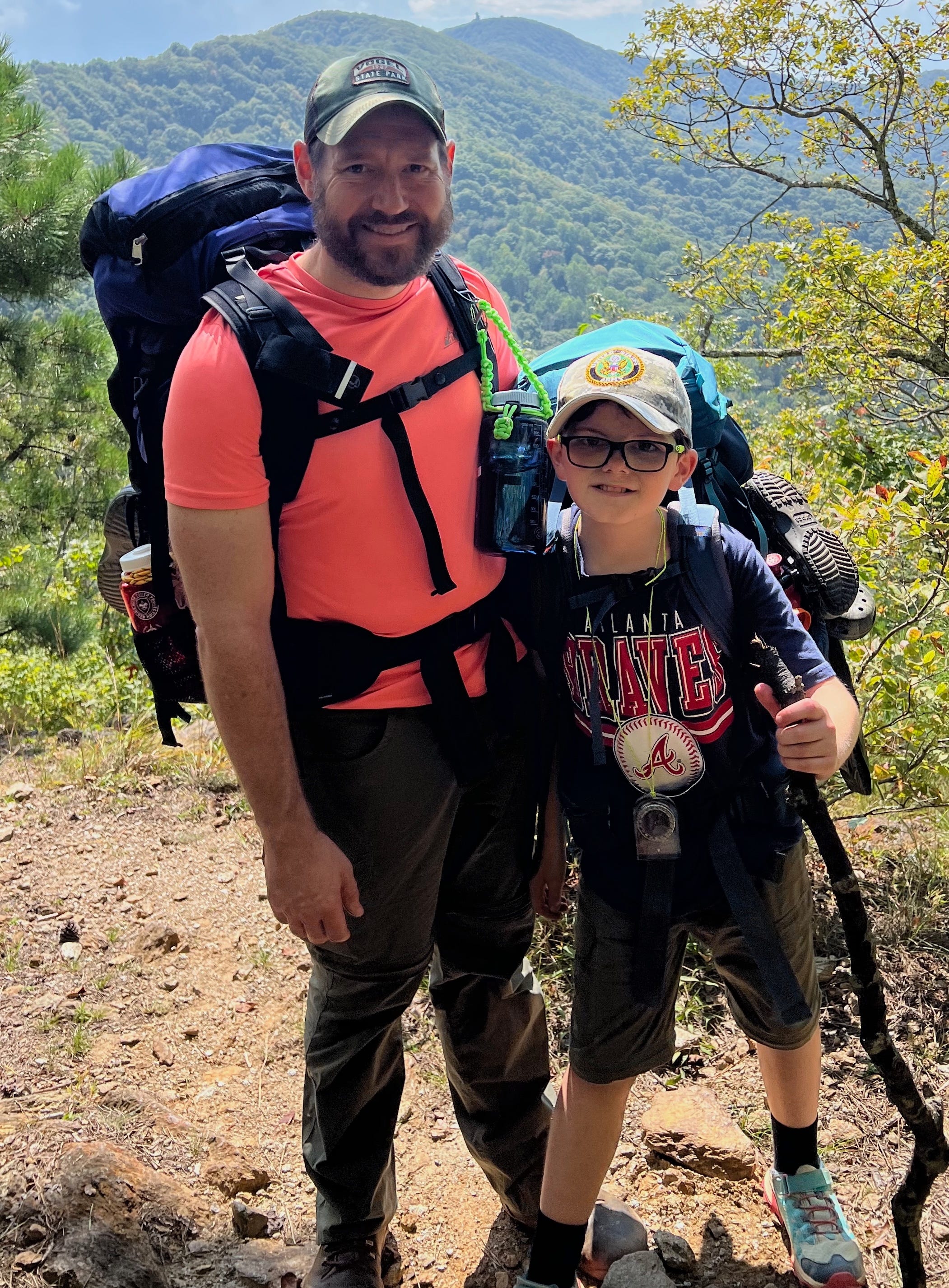
Anyway, that’s what I’ve been up to. Maybe now that I’ve broken through some writer’s block, I’ll get back to posting more regularly. Or not. I might just go outside.
It’s a fork of the open source Visual Studio Code.
One of my hesitations with using Cursor was that I didn’t have a local copy of our Zendesk Knowledge articles that Cursor would be able to reference. My friend pushed back, “just ask Cursor to download the articles via the API”. He was right. It was that easy, and now I have sync.py, written by cursor, which keeps our public documentation synced to my computer.
Cub Scouts—who are part of a Pack—goes from Kindergarten through 5th grade. Scouts—who are part of a Troop—goes (loosely speaking) from 6th grade to age 18.
Though, maybe, who knows.